
Ch-Molnár Éva: AVABLOG című műve Creative Commons Nevezd meg! - Ne add el! - Így add tovább! 3.0 Unported Licenc alatt van.
Az ezen publikus licenc hatáskörén kívül eső jogok megtekinthetőek itt: muforditas.bloglap.hu
Fejléckép: Erik Tjallinks, Creative Commons Nevezd meg! - Ne add el! - Így add tovább! 3.0 Unported Licenc,

- Visszhang - Megjelent norvégul az Utas és holdvilág
- G. Bogár Edit nyerte 2020-ban a Zsoldos-díj műfordítás kategóriáját
- MAGYAR HANGJA: MOGYORÓSI ZOLTÁN
- Műfordító képzések III - Hungarovox Oktatási Stúdió
- MAGYAR HANGJA: PAPOLCZY PÉTER
- Anne Goodwin: Becoming Someone
- Műfordítói öntudat, avagy #namethetranslator
- Translating Europe – roadshow fordítóknak
- MAGYAR HANGJA: FODOR ZSUZSA
- MAGYAR HANGJA: BORBÁS MÁRIA
- Topál Judit
Klasszikus keringő – Idegen nyelvek árnyalatai - avafordito
Klasszikus keringő – Idegen nyelvek árnyalatai - Topál Judit
Klasszikus keringő – Idegen nyelvek árnyalatai - Eszenyi Józsefné Éva
MAGYAR HANGJA: LENGYEL TÓTH KRISZTINA - avafordito
Liebster Award for AVABLOG from England - Annecdotist
Liebster Award for AVABLOG from England - avafordito
Kedves idetévedt műfordító kolléga! - Tímea
Kedves idetévedt műfordító kolléga! - avafordito
Ha futok, nincsenek rohamok – Tomán Edinával egyenesen a Határvonalról - Annecdotist
Ha futok, nincsenek rohamok – Tomán Edinával egyenesen a Határvonalról
Piaget in Formaldehyde - The Importance of Schemas in Translation
“Piaget was the first to study”...Formaldehyde...“cognitive development in children. The major components of his theory are”...Formaldehyde... What on earth...?? “Schemas, Adaptation, Assimilation and”...Formaldehyde... Uhhh, I seem to be a bit disoriented... “Accomodation.” No wonder. I've spent the last three hours listening to the Fundamentals of Online Education. The earplugs attached to my notebook are red hot. I badly need a tea.
Forma-what? Can't believe it's in the intermediate language exam... Nothing even similar in my dictionary. Cert fail. Dang.
“Pst”, the guy on the other side of the desk, “it translates «formalin»”. We both look around cautiously but none of the invigilators observe us. “It's a kind of preservative”, he adds.
“Thanks”, I mouth on him with a wry smile. Good God! A dead, stuffed sheep in a huge glass tank filled with this forma-something. Man, I'm only sixteen, what about my optimal emotional development? OK now stay focused! There' s still a lot to translate. But how did he know? He's got the same dictionary as me. Stay focused! Stay focused!”
“Hey! Thanks for the help with the preservative! How did you know?”, I asked him after the exam.
“Not from this dictionary, you bet!”, he laughed. “My dad's an ob-gyn, once he showed me a container filled with this liquid. A foetus was swaying in it.” Seeing the horror on my face, he laughed out. “Let's get something to drink before you throw up!” I could only moan my agreement. “A tea would be nice.”
...
“Schemas are units of understanding or linked mental representations stored and applied when needed.” It's much better now. A Lady Grey works wonders. Also, Professor Wirth's a brilliant lecturer. This course of hers on Coursera is rather a challenging expedition than an ordinary online course for which one pays a fortune and despite one's sweat and blood, it proves to be, well, ineffective. Just to be PC.
“Adaptation is the adjustment to the world. Assimilation is using existing schema to deal with new knowledge; while accommodation is the changing of existing schema because it does not work with new”...Formaldehyde... Oh no, not again! “knowledge.” This sheep-in-a-tank-of-preservative story really stuck in my mind... A sharp example of my juvenile translational inabilities.
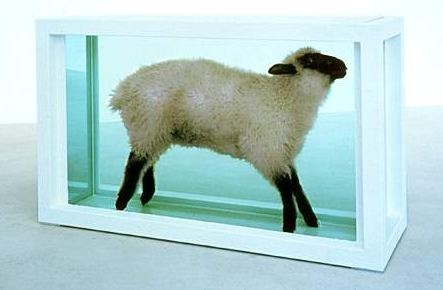
Damien Hirst: Sheep in Formaldehyde (Source: www.think-differently-about-sheep.com)
Well, at that time for most of the students preparing for language exams, the L2-L1 translation was bugaboo. Mainly due to lack of background information. I surely had nothing to assimilate in that certain case. So to say I did not have the schema vital to tackle that translation back in nineteen-ninety-something. Aaaaand: it made me panic. A never-fading memory of a dozen of butterflies with sharp stainless steel wings flapping in my belly. No matter how efficiently I could adjust to the world, I had little knowledge about it. I used to prefer reading novels and poetry to watching news.
Looking back it was like living in a cookie jar. Life was delicious there, but the view certainly limited. It was enough to realise, that literature and the English language were my directions to go, but provided no insight to further possibilities.I had a faint idea of becoming a literary translator in time, yet I knew hardly anything about what this profession requires or where to go to study the rudiments. I was kind of blithe. Whatever it means at the age of sixteen...
In my secondary school and university years I was scooting to measure up to the expectations with the constant feeling of lagging behind. However quickly I could build schemas there was always a new segment of science, culture or simply the world around me waiting to be discovered. Translation at that time seemed to be lengthy business. No proper access to the World Wide Web, and still not enough experience, patience and insight. It took me fifteen years to catch up.
Part of the story that half of it has been occupied by my children. In the meantime being on maternity leave lifted the academic burden. I could read whatever I wished for and the limited amount of free time enhanced my speed and efficacy. Also: great ideas come when changing nappies or making sand balls – after a while your brain is not needed there. :) Otherwise I MUST use my brain almost 24/7. The insatiable curiosity of my kiddies makes me constantly adapt and accommodate my existing or recently built schemas. That's what I call Life-long Learning. I've become coony and knowing. And have a notebook with fast internet access. Nowadays translation is recreation. And I still have a long way to go.
…
“Mummy, I'm NOT going up the stairs to Grandpa!”
“What's wrong, Honey?”
“Afraid of the fish-head on the wall, in the passageway...”, my second-born stands rooted at the gate.
“You know it can't harm you, don't you? It doesn't live any more. Grandpa put it...”
“...into formaldehyde”, he cuts into, “I know. It's toxic and stinky but it preserves that big, round and ugly fish-head. I hate it!” He puckers up his lovely little lips.
Schemas needed in the situation: ticked. Adaptation and assimilation: ticked. Emotional development: adequate to his age. Four-year-olds are not fan of big, round and ugly fish-heads nailed up on the wall. No matter how well they know the process of preservation.

 | Kategória: In English | Cimkék: piaget coursera translation language exam schemas | Hozzászólások
Oh yes, we've all been there, and Piaget's constructs are tricky in any language (even presumably the original French). Pity he didn't go on to research later life thinking styles, in which case he may well have been writing about the fixed formaldehyde position when we've done so much adapting to the world we don't want to do any more (or maybe I've always been that).
Good to get the translator's perspective on things and I feel I'm lucky, as a writer, to be able to skirt around my ignorance if I choose to.But it's good to see you've started your background research to put you in the running for translating my novel Sugar and Snails (if it ever gets published) into Hungarian! While there is no mention of assimilation and accommodation, it does address a child's difficulty in adapting to the world and there's a passing reference to formaldehyde in what I hope is the appropriate setting of a 1940s field hospital.